
Article
Introducing BRAM: An MCP Gateway for Production AI Agents
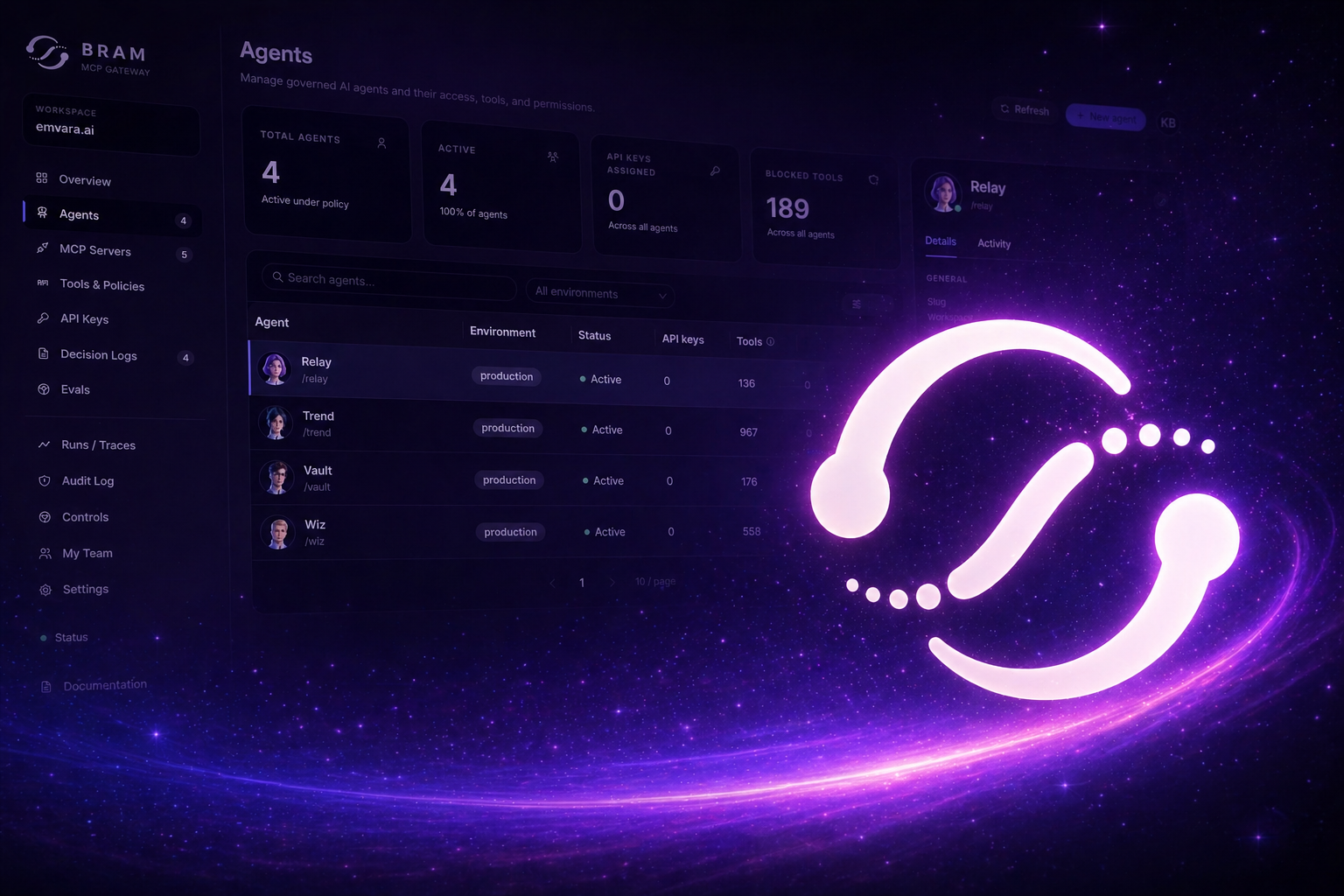
I'm excited to share a new product I'm building with a friend who is now the co-founder of BRAM.
The idea started from a mix of inspiration and necessity. My friend helped sharpen the way I was thinking about agentic software: not just as chat interfaces, but as systems that can reason, connect to tools, and perform real work. That perspective stuck with me as I kept building products under Fluenik, especially Humagician and Uptivus.
The deeper I got into those products, the clearer the problem became.
AI agents are becoming useful because they can use tools. But the moment an agent can call tools, update systems, trigger workflows, or inspect sensitive operational data, a new question appears:
Who is watching the agent?
Where the Need Came From
Humagician is built around inbound automation. It brings together chat, forms, support workflows, knowledge bases, and AI-assisted task execution. The AI assistant in that product is not meant to simply suggest replies forever. It is designed to help complete work.
Uptivus has a different surface area, but the same underlying pressure. It monitors uptime, detects incidents, routes alerts, and uses AI to help make sense of operational signals. As the product evolves, agents need to reason across monitoring data and connect with the tools teams already use.
Both products pointed toward the same future: agents connected to external systems through MCP servers.
That is powerful, but it also creates risk. If every product connects agents directly to MCP servers, every product has to solve the same set of problems on its own:
- Which tools can this agent access?
- Which actions should be blocked, allowed, or approved first?
- What happened before and after the tool call?
- Did the agent expose sensitive information?
- Did the agent follow policy?
- Can we evaluate the agent's behavior later?
I did not want those questions buried separately inside each app. They needed their own layer.
What BRAM Is
BRAM is an MCP gateway for production AI agents.
It sits between AI agents and the MCP servers they call. Instead of pointing an agent directly at every tool server, the agent points at BRAM. From there, BRAM can observe traffic, enforce policies, apply guardrails, and preserve a trace of what happened.
The goal is simple: make agent-tool traffic governable.
BRAM is being designed around three core needs:
- Observability: capture every agent-tool call so teams can see what happened
- Policy enforcement: decide centrally what agents are allowed to do
- Evaluations and guardrails: check behavior both inline and after the fact
That combination matters because AI agent safety is not just about blocking bad prompts. It is about understanding the full lifecycle of a decision: what the user asked, what the agent decided, which tool it called, what came back, and whether the final outcome matched the intended policy.
Why an MCP Gateway Matters
MCP gives agents a common way to connect with external tools. That is the exciting part. It also means agent systems can grow from a few tools to many tools quickly.
Without a gateway, that growth can turn messy. Access rules spread across projects. Audit logs live in different places. Tool approvals become inconsistent. Evals happen too late. Security becomes a feature each product has to reimplement.
BRAM gives that responsibility a home.
It is meant to become the control plane between agents and tools: a place where teams can define rules once, review behavior across products, and improve agent reliability over time.
Building It With a Co-Founder
One of the most meaningful parts of BRAM is that it is not something I am building alone.
The original spark came from conversations with a friend who understood where agentic software was heading and helped push the idea from "this is a problem" into "this should be a product." That friend is now the co-founder of BRAM.
That matters to me because BRAM is not just another side project. It came from real product work, real conversations, and a shared belief that AI agents need better infrastructure before they can be trusted with more important work.
What's Next
BRAM is still early, but the direction is clear.
Humagician and Uptivus showed me where agentic products are going. BRAM is the gateway I wish I already had while building them: one place to watch agent behavior, enforce boundaries, review sensitive actions, and evaluate whether the system is improving.
AI agents are going to keep getting more capable. As they do, the infrastructure around them has to mature too.
That is what BRAM is being built for.